Data Science Syllabus 2026: Full Module Breakdown
By Tutorac Editorial Team · Updated 30 June 2026
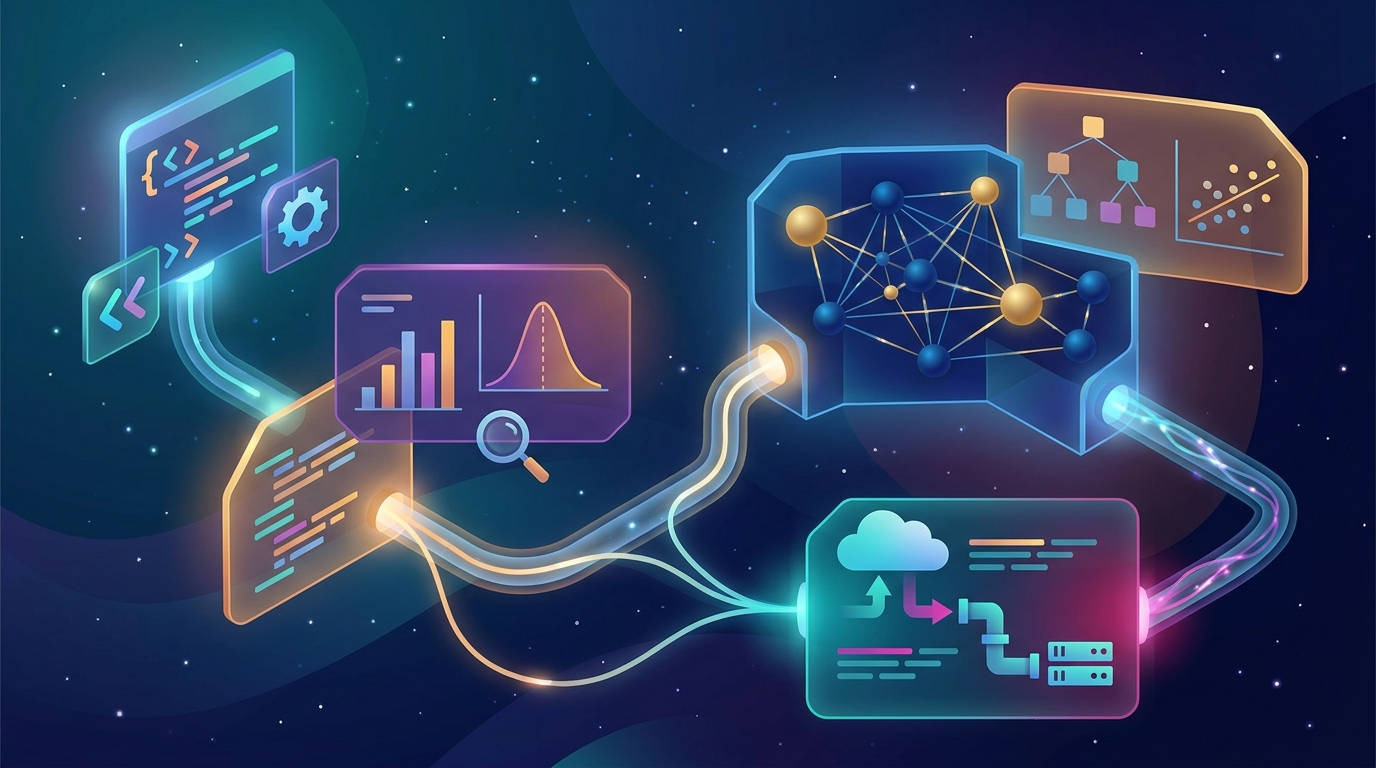
A data science syllabus is the structured curriculum that takes you from raw fundamentals to job-ready skills. In 2026 it spans ten core modules: Python and SQL programming, statistics, data wrangling, visualization, machine learning, deep learning, big data and cloud, generative AI, MLOps, and a capstone portfolio project that proves you can ship real work.
Key takeaways
- A complete data science syllabus covers 10 modules across roughly 6–12 months of focused study.
- Python, statistics, and machine learning form the non-negotiable core every employer expects.
- 2026 syllabi now add generative AI, LLMs, and MLOps — the fastest-growing hiring signals.
- You do not need a maths degree; high-school algebra plus applied statistics is enough to start.
- The single most important deliverable is a portfolio of 3–5 projects, not just certificates.
What is a data science syllabus?
A data science syllabus is the ordered list of subjects, tools, and projects a course uses to turn a beginner into a working data professional. Think of it as a roadmap: each module builds on the last, moving from how to handle data to how to model it to how to deploy and communicate results. A strong syllabus is outcome-oriented — every topic maps to a skill an employer will pay for, whether that is cleaning messy data, training a predictive model, or shipping it to production.
The best 2026 curricula share the same backbone but differ in depth. A 3-month bootcamp compresses the essentials; a 12-month program adds deep learning, big data engineering, and specialization tracks. Below is the full breakdown, module by module, with what you learn and why it matters for the job market.
Data science syllabus at a glance (2026)
Here is the complete 10-module syllabus most top programs follow, with typical time investment and the career skill each unlocks.
| Module | Core topics | Typical duration | Job skill unlocked |
|---|---|---|---|
| 1. Programming | Python, SQL, R basics | 4–6 weeks | Manipulate and query data |
| 2. Maths & statistics | Probability, inference, linear algebra | 3–5 weeks | Reason about uncertainty |
| 3. Data wrangling & EDA | Pandas, cleaning, feature engineering | 3–4 weeks | Prepare real-world data |
| 4. Data visualization | Matplotlib, Seaborn, dashboards | 2–3 weeks | Communicate insight |
| 5. Machine learning | Regression, classification, clustering | 6–8 weeks | Build predictive models |
| 6. Deep learning | Neural networks, CNNs, NLP | 4–6 weeks | Solve unstructured-data problems |
| 7. Big data & cloud | Spark, AWS/Azure, pipelines | 3–4 weeks | Work at scale |
| 8. Generative AI & LLMs | Prompting, RAG, fine-tuning | 3–4 weeks | Build modern AI apps |
| 9. MLOps & deployment | APIs, Docker, monitoring | 2–3 weeks | Ship models to production |
| 10. Capstone & portfolio | End-to-end projects | 4–6 weeks | Prove job readiness |
Module 1: Programming for data science
Every data science syllabus opens with programming because nothing else works without it. Python is the dominant language — you will learn variables, loops, functions, and the core libraries NumPy and Pandas. SQL is equally essential for pulling data from relational databases; expect to master SELECT, JOIN, GROUP BY, and window functions. Some programs introduce R for statistics-heavy roles, but Python first is the safest 2026 choice.
By the end of this module you should comfortably read a CSV, filter rows, aggregate values, and write a reusable function. If you are starting from zero, our Python for Data Science roadmap sequences exactly what to learn first.
Module 2: Mathematics and statistics
Statistics is what separates a data scientist from a report builder. The syllabus covers descriptive statistics (mean, variance, distributions), probability, hypothesis testing, confidence intervals, and the linear algebra (vectors, matrices) that powers machine learning. You will also touch calculus concepts like gradients, which explain how models learn.
Good news: you don’t need a maths degree. Most programs teach applied statistics — enough to choose the right test, interpret a p-value, and avoid misleading conclusions. Roughly 3–5 weeks of consistent practice covers it.
Why statistics matters for hiring
Interviewers routinely ask candidates to explain overfitting, the bias-variance tradeoff, or how to validate an A/B test. These all rest on the statistics module, which is why skipping it is the most common reason learners stall.
Module 3: Data wrangling and exploratory data analysis (EDA)
Real data is messy — missing values, duplicates, inconsistent formats. This module teaches data cleaning, feature engineering, and exploratory data analysis using Pandas. You learn to spot outliers, handle nulls, encode categories, and summarize a dataset before modeling. Surveys consistently show data scientists spend up to 60–80% of their time here, so employers test it heavily.
Module 4: Data visualization and storytelling
Insight that can’t be communicated is worthless. This module covers Matplotlib and Seaborn for charts, plus dashboarding tools like Power BI or Tableau. You learn which chart fits which question, how to design for a non-technical audience, and how to build a narrative from data. Strong visualization skills are what get junior analysts promoted, because they translate models into decisions executives act on.
Module 5: Machine learning
This is the heart of the syllabus. You progress through three families of algorithms:
- Supervised learning — linear and logistic regression, decision trees, random forests, gradient boosting (XGBoost), for prediction and classification.
- Unsupervised learning — k-means clustering, PCA, and dimensionality reduction for finding hidden structure.
- Model evaluation — train/test splits, cross-validation, precision, recall, F1, ROC-AUC, and hyperparameter tuning.
You will use scikit-learn as the workhorse library. Expect 6–8 weeks here — it is the deepest module and the one most interview questions target.
Module 6: Deep learning and neural networks
Deep learning extends machine learning to unstructured data — images, text, and audio. The syllabus introduces neural networks, backpropagation, convolutional neural networks (CNNs) for vision, and recurrent/transformer architectures for natural language processing. Frameworks are usually TensorFlow or PyTorch. Not every role needs deep mastery, but a working understanding is now expected even for generalist data scientists.
Module 7: Big data and cloud
When datasets outgrow a laptop, you need distributed tools. This module covers Apache Spark, data pipelines, and cloud platforms — AWS, Azure, or Google Cloud. You learn to store, process, and query data at scale, and to run training jobs on cloud compute. For learners eyeing cloud-heavy roles, our guide to becoming a data scientist in 2026 maps how these skills combine on the job.
Module 8: Generative AI and large language models (the 2026 addition)
The biggest change to the data science syllabus in the last two years is the addition of generative AI. Modern programs now teach prompt engineering, working with large language model (LLM) APIs, retrieval-augmented generation (RAG), embeddings and vector databases, and the basics of fine-tuning. Employers increasingly expect data scientists to build AI-powered features, not just dashboards — making this module a genuine hiring differentiator in 2026.
Module 9: MLOps and model deployment
A model that lives in a notebook earns nothing. MLOps teaches you to take a trained model into production: wrapping it in an API (FastAPI/Flask), containerizing with Docker, version control with Git, automated testing, and monitoring for model drift. This module bridges data science and engineering and is the fastest path to a senior salary because so few candidates have it.
Module 10: Capstone projects and portfolio
The final module is where everything comes together. You complete end-to-end projects — sourcing data, cleaning it, modeling, deploying, and presenting results. A portfolio of 3–5 strong projects on GitHub matters more to recruiters than any certificate, because it proves you can do the work. Aim for variety: one classic ML project, one NLP or generative-AI project, and one full deployment.
Prerequisites: do you need maths and coding?
This is the most common fear, and the honest answer is reassuring. You need:
- Maths: comfort with high-school algebra and a willingness to learn applied statistics. No advanced calculus required to start.
- Coding: none in advance. The syllabus assumes you begin from zero in Module 1.
- Mindset: curiosity, problem-solving patience, and 8–12 hours a week of consistent practice.
If anything is missing, it is usually consistency — not talent. A tutor who keeps you accountable closes that gap faster than any video course.
How long does the data science syllabus take?
Duration depends on your pace and prior background. Typical timelines:
- Intensive bootcamp (full-time): 3–4 months covering the core 7 modules.
- Part-time program: 6–9 months, the most common route for working professionals.
- Self-paced with a tutor: 9–12 months including deep learning, MLOps, and a full portfolio.
The variable that matters most is weekly hours. At 10 hours a week, the complete syllabus is realistically a 9–12 month journey to job readiness.
Beginner vs advanced syllabus: what’s the difference?
A beginner syllabus stops after machine learning and visualization — enough for data analyst and junior data scientist roles. An advanced syllabus adds deep learning, big data engineering, generative AI, and MLOps, targeting senior data scientist and ML engineer roles. Start with the beginner core, land a first role, then layer the advanced modules while earning. There is no need to learn everything before applying.
Tools and technologies you’ll learn
Across the syllabus you will become fluent in: Python, SQL, Pandas, NumPy, scikit-learn, Matplotlib, Seaborn, TensorFlow or PyTorch, Apache Spark, Git, Docker, a cloud platform (AWS/Azure/GCP), and at least one BI tool (Power BI or Tableau). You don’t need to master all at once — each tool is introduced in the module where it is used.
From syllabus to job: roles, outcomes, and salaries
Completing this syllabus opens several roles: data analyst, data scientist, machine learning engineer, business intelligence analyst, and data engineer. According to the U.S. Bureau of Labor Statistics, data scientist employment is projected to grow far faster than the average for all occupations through the decade, with a strong median wage — a reflection of sustained demand. The path is simple: finish the modules, build the portfolio, and practice interview questions tied to each topic.
Not sure where to begin or how to stay on track? A 1:1 mentor turns this syllabus into a weekly plan with feedback on your code and projects.
Frequently asked questions
What subjects are included in a data science syllabus?
A complete syllabus covers programming (Python and SQL), mathematics and statistics, data wrangling, data visualization, machine learning, deep learning, big data and cloud, generative AI, MLOps, and a capstone portfolio project — ten modules in all.
What is the data science syllabus for beginners?
Beginners start with Python programming, applied statistics, data cleaning with Pandas, and visualization, then move into core machine learning with scikit-learn. Deep learning and MLOps can wait until after your first role.
How long does it take to complete a data science course?
A full-time bootcamp takes 3–4 months; part-time programs run 6–9 months; self-paced study with a tutor typically takes 9–12 months at around 10 hours per week.
Do I need maths or coding before starting?
No prior coding is required — the syllabus begins from zero. For maths, high-school algebra plus applied statistics taught within the course is enough. You do not need a maths degree.
Is Python or R better for the data science syllabus?
Python is the better first choice in 2026 because of its dominance in machine learning, deep learning, and generative AI. R remains useful for statistics-heavy research roles but is optional.
What’s new in the 2026 data science syllabus?
The biggest additions are generative AI and large language models (prompting, RAG, fine-tuning) and stronger MLOps coverage. Both are now major hiring signals employers actively screen for.
Start learning with a structured plan
The syllabus is clear — execution is everything. Browse Tutorac’s data science video courses to follow a structured curriculum, explore the full data science blog hub for deeper guides, or find a data science tutor to turn this roadmap into a personalized weekly plan with real accountability. For a wider view of programs, fees, and outcomes, see our 2026 data science online course guide.
Continue learning
About the author
The Tutorac Editorial Team brings together experienced instructors and working tech professionals who teach and mentor on Tutorac. We publish practical, up-to-date guides to help learners pick the right courses, certifications, and career paths. Find a tutor or explore courses.












Add a comment